


ANPR stands for Automatic Number Plate Recognition.
Automatic Number Plate Recognition (ANPR) cameras have long enhanced safety, security, and efficiency. This technology can instantly recognise and record vehicle license plates, even in low light or poor weather conditions.
ANPR cameras are widely used in applications such as traffic management, crime prevention, parking enforcement, and toll collection. This article explains how ANPR cameras work, their benefits, and their diverse applications.
What is ANPR?
How Does an ANPR Camera Work?
ANPR cameras capture and analyse vehicle license plates using advanced technology. Here’s a simplified overview of the process:
- Image Capture:
- High-resolution cameras, often with infrared lighting, capture clear images of vehicle license plates under various conditions.
- Scene illumination ensures that the license plate is visible even in low-light conditions.
- Plate Detection:
- The software processes the image to detect the license plate area. This step involves analysing the reflectance of the license plate.
- Character Segmentation:
- The detected plate is further processed to isolate individual characters- adjustments such as the F-stop in the camera help in capturing usable video.
- Optical Character Recognition (OCR):
- OCR technology converts isolated characters into digital text. Cameras with Automatic Gain Control (AGC) help optimise image quality for better OCR accuracy.
- Data Processing:
- The recognised license plate information, along with additional data (e.g., date, time, location), is stored in a database.
- Real-Time Use or Storage:
- The data can be used immediately for tasks like alerting authorities or stored for future reference, such as parking management or security monitoring.
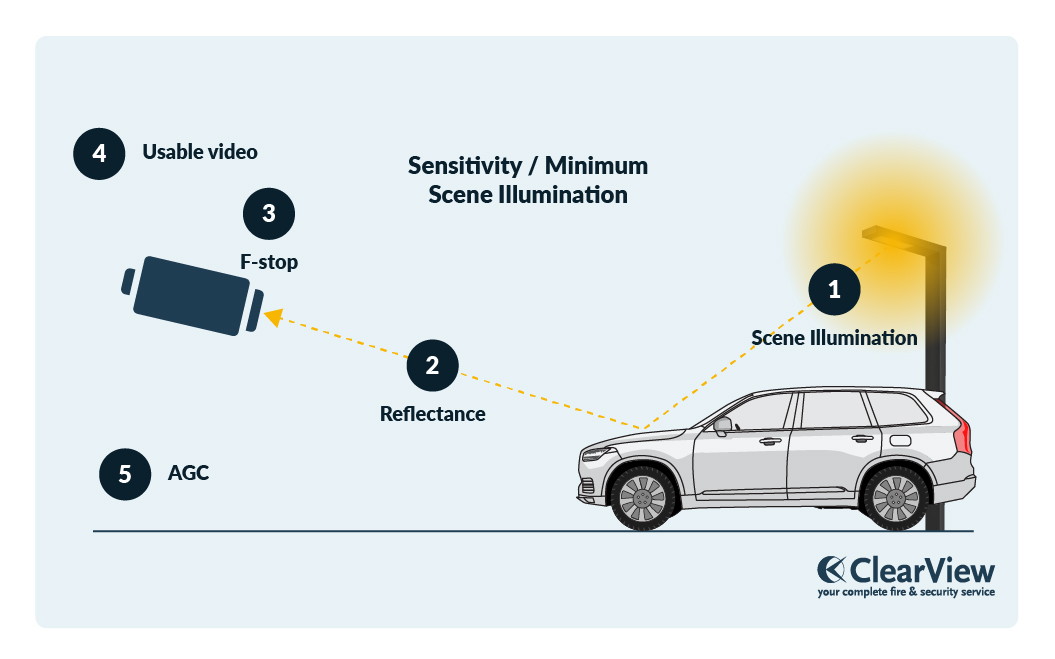
This infographic illustrates the process of capturing usable video footage of a vehicle’s license plate using an Automatic Number Plate Recognition (ANPR) system:
- Scene Illumination: Adequate lighting is crucial to illuminate the vehicle’s license plate for clear visibility. Infrared (IR) lighting is frequently used in ANPR systems because it avoids visible light exposure, reducing the potential for driver distraction.
- Reflectance: The system then analyses the reflectance of the license plate to ensure the plate numbers are detectable even under varying light conditions.
- F-stop: The camera automatically adjusts its aperture setting (F-stop) to control light levels, ensuring sharp image clarity and proper depth of field.
- Usable Video: All of these adjustments ensure the camera captures clear, high-quality video that can be accurately processed by the ANPR system.
- AGC (Automatic Gain Control): AGC automatically adjusts the camera’s sensitivity to light, helping maintain consistent image quality in changing conditions such as bright sunlight, shadows or night-time driving.
This step-by-step flow ensures that the ANPR system effectively captures and processes license plate information under diverse environmental conditions.
Applications of ANPR Cameras
ANPR cameras are highly versatile, which is why they’re used in a wide variety of applications. The technology is primarily used by two main groups:
- Law enforcement agencies (LEAs), including the police
- Private organisations and public bodies, such as companies, local authorities and the Department for Transport (DfT)
Let’s explore some of their most common uses:
Traffic Management and Control
ANPR enables efficient traffic flow monitoring. For instance, in cases of traffic rule violations such as speeding or running a red light, the camera can capture the offender’s plate number, which can be later used for enforcement.
ANPR technology is used in a number of motorway cameras to measure the average speed between two points by comparing vehicle timestamps, helping authorities enforce speed limits more effectively. For example, ANPR is used in London to enforce congestion charges, improve traffic flow, and reduce pollution.
Parking Enforcement
ANPR cameras help manage parking in private and public car parks. They record the time when a vehicle enters and exits the car park, making it easier to manage parking spaces and billing.
This enables ticketless parking systems, where drivers are automatically charged based on how long they stay. Many shopping centres use ANPR to automatically charge registered vehicles for their parking time, which saves customers time and improves their shopping experience.
Security and Surveillance
Another use case for ANPR cameras is security and surveillance. These cameras identify and track criminal activity and stolen vehicles. The system can alert security personnel or the police when a match is found.
Police use ANPR to detect, deter and disrupt criminality, from identifying uninsured or untaxed vehicles to locating stolen v
The Driver & Vehicle Standards Agency (DVSA) use ANPR to help detect, deter and disrupt unlicenced drivers and untested vehicles.
Toll Collection and Congestion Charging
For toll roads, bridges, or congestion charging zones, ANPR can automate the collection process. Vehicles passing through are identified, and charges can be applied without the need for manual operations or physical toll booths, improving efficiency and reducing congestion.
In 2021, Transport for London operated a network of 1,544 ANPR cameras to monitor and enforce:
- The Central London Congestion Charging Scheme
- The Central London Ultra Low Emission Zone (ULEZ)
- The Central London Emission Zone (LEZ)
- Direct Visition Standards (DVS)
- HGV Safety Permit Schemes
Access Control
ANPR technology is also crucial for controlling and tracking vehicle access in secure areas. It ensures that only authorised vehicles are allowed entry, enhancing security and efficiency. For example, many gated communities and secure facilities use ANPR to automatically grant access to vehicles that are registered in their system. This not only improves security but also streamlines the entry process for residents and authorised personnel.
What happens to data captured by ANPR cameras?
The National ANPR Service (NAS) is the UK law enforcement system responsible for storing and managing data captured by ANPR cameras across the country. It allows police to track where vehicles have been and link them to locations or potential criminal activity- something that would otherwise be much harder to do.
The initiative allows for easy accessibility of data and aims to ensure “data is stored, accessed and used in a proportionate manner so that the privacy of individuals is respected.”
Staff only have access to data if it’s relevant to their role. Most of those who have permission only do so for a maximum of 90 days from the date it was collected.
The National ANPR Standards for Policing and Law Enforcement state that “access to ANPR data must be proportionate to the circumstances of that access and take account of the impact on the fundamental rights and freedoms of individuals”
They also outline that “ANPR READ records must be deleted within 12 months of capture, unless there is a legal requirement to retain them under the Criminal Procedure and Investigations Act 1996 (CPIA) or similar legislation”
Private companies may access vehicle and registered keeper data from the DVLA if they can demonstrate reasonable cause. To do so, they must also be members of an Accredited Trade Association, such as the British Parking Association (BPA) or the International Parking Community (IPC). They do not have access to data held within police ANPR databases.
Integrating ANPR with Other Systems
The usefulness of ANPR technology increases when integrated with other security or traffic systems. For instance, ANPR can be combined with CCTV surveillance systems for broader security coverage. In access control systems, ANPR can automate the entry and exit of authorised vehicles, enhancing security and efficiency but also eliminates the need for manual checks, speeding up the entry process and lowering the risk of human error.
ANPR technology, with its capacity to recognise license plates rapidly and accurately, provides a range of benefits. Its applications stretch beyond simple security and surveillance, extending to traffic and parking management, law enforcement, and more. The future may see even broader uses as ANPR technology continues to evolve and integrate with other systems.
Key Takeaways
ANPR cameras utilise advanced optical character recognition technology to capture and analyse vehicle license plate images rapidly and accurately.
They can function effectively under challenging conditions like poor weather or low light, making them a reliable tool for various applications.
Key applications of ANPR cameras include traffic management, parking enforcement, toll collection, and security surveillance.
ANPR technology can assist law enforcement by identifying and tracking stolen vehicles or those involved in criminal activities.
In parking management, ANPR cameras can help monitor parking occupancy, duration, and violations.
For toll roads and bridges, ANPR cameras can automate the collection process, enhancing efficiency and reducing congestion.
The integration of ANPR with other systems like CCTV cameras or automated gates increases its usefulness and effectiveness.
The versatility of ANPR technology points towards a future where it could play a pivotal role in the development of smart cities and intelligent transportation systems.

